Nick bribes Holden! Reveals Mitch’s shocking identity to Nick Young And The Restless Spoilers

In The Young and the Restless: The Revelation of Mitch, Genoa City becomes a maze of secrets, blackmail, and betrayal. Power shifts like quicksand in this high-stakes psychological drama, where one bribe and one revelation threaten to unravel the very foundation of the Newman legacy.
The film opens with a sleek aerial shot of Genoa City at dusk — the lights of skyscrapers shimmering against the dark water. In his penthouse, Nick Newman stands alone, staring at a folder on his desk. Inside lies a secret capable of blowing apart not only his family’s empire but his own sense of identity. The folder bears one name in bold: Mitch.
Nick’s life has already been a balancing act — juggling his loyalty to Victor, his strained ties with Adam, and his fragile relationship with Sharon and their son. But when an enigmatic man named Holden resurfaces in town, claiming to know something about Mitch, Nick realizes the past he thought was buried may be coming back to life.
The first act unravels with noir-like intensity. Holden, a former private investigator turned information broker, makes his presence known at Crimson Lights, his demeanor calm but calculating. He drops a hint that he possesses documents tying Mitch to someone within the Newman family — and that the information has a price. Nick, suspicious but desperate, agrees to meet him privately.
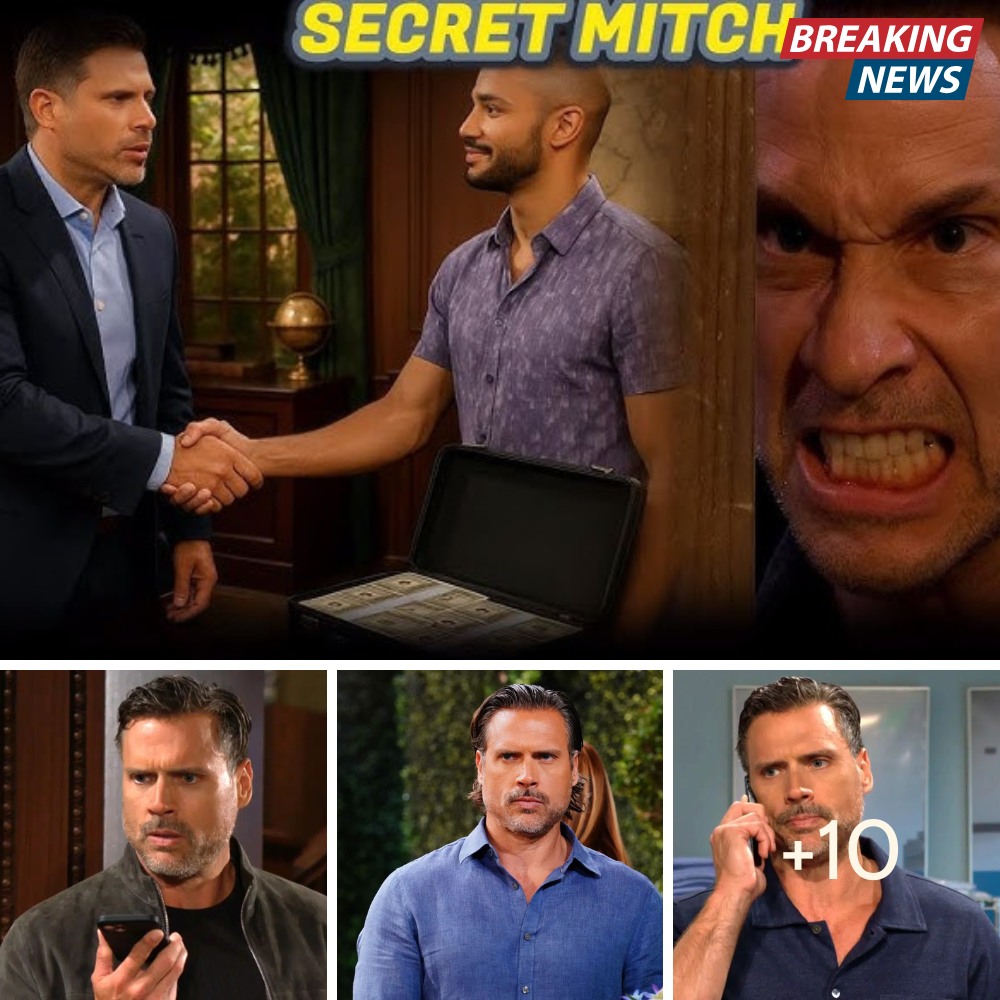
Their meeting plays out like a chess match in shadows. Inside the dimly lit parking garage, Holden leans against his car, cigarette smoke curling around him. “Everything comes with a cost,” he says, “even the truth.” Nick counters with cold precision, sliding a briefcase across the hood — filled with cash. His voice is low but resolute: “Tell me what I need to know.”
The bribe seals their unholy pact. But Holden’s revelation doesn’t just shake Nick — it detonates everything he thought he knew. In a chilling twist, Holden reveals that Mitch is not a stranger at all. Mitch is connected by blood — a Newman by birth, hidden for decades under a different name. The revelation sends shockwaves through Nick’s mind. His family, already fractured, now carries another explosive secret: Mitch is Victor’s illegitimate son — and possibly Adam’s half-brother.
As the second act unfolds, the emotional tension builds into a storm. Nick returns to Newman Enterprises, his face pale, his demeanor shaken. He paces Victor’s office, wrestling with what to do. Does he confront his father? Does he tell Adam? Or does he bury the truth and let the lie live on?
The cinematography mirrors his turmoil — reflections in glass, blurred city lights, fragments of memory. Flashbacks depict Victor’s past affairs, the mysterious years when Mitch would have been conceived, and the shadows of deals made long before Nick ever took his first breath.
Meanwhile, Holden disappears from town as suddenly as he appeared, leaving behind cryptic messages hinting that others — perhaps even Victor himself — wanted this truth to stay hidden. Nick realizes too late that by bribing Holden, he’s walked straight into a trap: the bribe was recorded, the evidence planted. Someone wants Nick to be the fall guy for what’s coming next.
The film’s second half becomes a race against time. Adam catches wind of Nick’s secret meetings and confronts him in the Newman boardroom. The two brothers clash in one of the movie’s most electrifying scenes — anger, betrayal, and pain exploding like shrapnel. “You always thought you were the better man,” Adam spits, “but you’re just like him.”
Nick, fists clenched, finally snaps back: “At least I still have a soul.”
But even as their fight intensifies, Nick knows he must face Victor. The confrontation between father and son anchors the movie’s emotional climax. In the quiet of Victor’s study, Nick lays down the truth. “You lied to all of us,” he says, voice trembling. “You hid another son. Mitch isn’t just a ghost from your past — he’s our blood.”
Victor’s face hardens, then cracks — a rare moment of vulnerability. “I did what I had to do,” he says coldly. “Not every truth needs to be told.” The camera lingers on the two men — father and son, legacy and conscience — locked in a war that neither can win.
The revelation leaves Nick hollow. He returns to the empty Newman Ranch, staring at the family portraits that now feel like lies. In the film’s final act, Phyllis appears — the only person who sees through his façade. “You found something you can’t unlearn,” she says softly. He nods. “It’s not just a secret,” he replies. “It’s a curse.”
As the movie nears its end, Nick burns Holden’s file in the fireplace. Flames consume the papers, but the guilt remains. The camera pans upward, catching his reflection in the glass — fractured, haunted, and uncertain of who he really is anymore.
The closing voiceover delivers the film’s haunting final note:
“In Genoa City, truth doesn’t set you free — it buries you deeper.”
The screen fades to black, leaving viewers suspended in the aftermath of revelation and regret — and wondering who will weaponize the truth next.
In The Young and the Restless: Tuesday Reckoning, the city of Genoa faces another day drenched in betrayal, passion, and reckoning. The movie adaptation transforms the soap’s emotional intensity into a cinematic rollercoaster — a story about power, redemption, and the dangerous truths that refuse to stay buried. On this fateful November 4th, every alliance is tested, every secret edges closer to exposure, and one shocking decision changes everything.
The film opens with the sweeping skyline of Genoa City at sunrise, bathed in gold and tension. The Newman, Abbott, and Winters families are all poised for conflict. In the opening scene, Victor Newman stands before the massive windows of Newman Enterprises, reflecting on decades of triumphs and betrayals. His empire is thriving — but his family is splintered. A man who built his fortune on control now faces the one thing he can’t command: the hearts of those he loves.
Meanwhile, Nick Newman finds himself at a crossroads. After recent revelations about Mitch’s identity and Holden’s manipulation, Nick’s loyalty to his family teeters on the edge. He’s torn between doing what’s right and protecting the Newman name. The film captures his turmoil in moody cinematography — the flicker of city lights mirrored in his troubled eyes, the echo of past mistakes haunting his every move. When Sharon confronts him about keeping secrets, their exchange crackles with restrained emotion. “You can’t fix this by staying silent,” she pleads. But Nick knows that truth in Genoa City is rarely the solution — it’s the spark that ignites chaos.
Across town, Phyllis Summers has her own storm brewing. She’s been trying to rebuild her life, her business, and her sense of self, but an unexpected call from Jack Abbott pulls her back into old wounds. Their chemistry still burns beneath years of heartbreak, and in one emotionally charged scene, Jack admits the company feels empty without her sharp wit and fire. Yet his confession hides another truth — he’s considering leaving Jabot for good. Phyllis senses it instantly. “You can’t keep walking away from everything you build,” she whispers. But Jack’s eyes say what words can’t: sometimes, the fight costs more than the victory.
While these emotional fires burn, Adam Newman is once again playing his own dangerous game. Still haunted by his past sins, he’s determined to prove himself — to Victor, to Sally, and to himself. But his version of redemption comes with risk. When he discovers that someone has been leaking confidential Newman files, suspicion falls on an unexpected source: his own father. The scenes between Adam and Victor are electric — two men cut from the same ruthless cloth, staring each other down like gunfighters at dusk. “You taught me to fight dirty,” Adam says. “Don’t be surprised when I do.”
Meanwhile, Lily Winters and Devon Hamilton are fighting to protect Chancellor-Winters from a silent takeover. The movie version amplifies their storyline into a corporate thriller, complete with boardroom betrayals and whispered deals. Nate Hastings, still struggling with guilt and ambition, returns with an offer that could either save their company or destroy it. Lily’s quiet strength shines as she faces him down. “You want forgiveness,” she tells him, “but what you really want is control.”
Amid all the business warfare and family betrayal, the emotional centerpiece of the movie belongs to Chelsea Lawson and Billy Abbott. Their relationship, fragile but hopeful, faces a new test when Chelsea receives devastating news about Connor’s mental health. The sequence in which she breaks down, with Billy silently holding her, is one of the film’s most powerful moments — raw, intimate, and deeply human. For a moment, all the money and manipulation fade, replaced by something real: pain and love intertwined.
As the film barrels toward its third act, the storylines begin to collide. Victor summons his family to the Newman Ranch for an emergency meeting — a cinematic gathering filled with slow camera pans, tense silences, and half-revealed truths. Nick arrives late, holding a folder that could destroy them all. Jack, freshly disillusioned, watches from the sidelines, torn between rival empires. Phyllis shows up uninvited, her entrance turning heads as only she can.
Then comes the twist — a revelation that shakes every character to their core. The documents Nick holds prove that someone inside Newman Enterprises has been manipulating stock transactions to frame Adam — and the culprit isn’t who anyone expected. Gasps echo through the room as the truth lands like a thunderclap. Victor’s composure shatters; Adam’s fury ignites; Phyllis’s eyes widen with stunned understanding. The house of cards begins to fall.
The final sequence is quiet but loaded with emotion. Nick, exhausted, walks out into the cold November night, the city lights shimmering behind him. Sharon catches up to him, placing a hand on his arm. “You did what you had to,” she says softly. He shakes his head. “No,” he replies, voice breaking. “I did what I swore I’d never do — I became my father.”
The camera lingers on his face as he looks up at the sky, searching for something beyond redemption — perhaps peace. The music swells, blending piano and strings, as the film fades to black on the Newman tower glowing like a beacon and a warning.